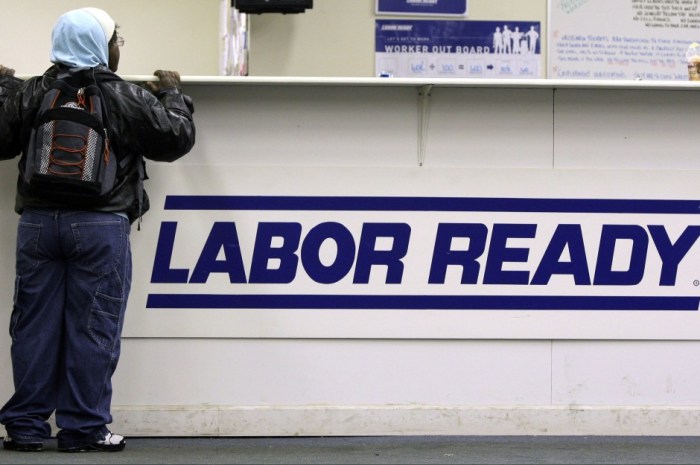
How Employment Agencies Abuse Job Seekers

Image courtesy of Talkpoverty.org article.

If you don’t have a job, or you want a better one, advertisements like these may seem promising:

CLEANERS – NOW STAFFING – F/T & P/T, no exp needed. Up to $29.00 per hour.

The U.S. economy continues to improve and the unemployment rate is decreasing, reaching a seven-year low of 5.2 percent in New York City in September, according to the New York State Department of Labor. But many people are still looking for a job or seeking a better one, which can be a stressful and time-consuming process. Lured by advertisements and the promise of work, some turn to an employment agency for help.

The New York City Department of Consumer Affairs (DCA), which I serve as Commissioner, licenses and regulates employment agencies. While we are very vigilant in our protection of job seekers, with such a high demand for services and many people desperately in need of work, there are inevitably those who try to take advantage of vulnerable individuals. This has led to a proliferation of predatory employment agencies that exploit the unemployed or underemployed who are trying their best to provide for their families.

One of these individuals was Rosa. After paying $125 to an employment agency, the agency sent her to a laundromat that they claimed was looking for workers. However, when Rosa went to inquire about the job, the owner of the laundromat said they were not hiring and had never asked for workers. Rosa returned to the employment agency asking for a refund, but was refused one. Their only response to her was that she was “too old” and so the laundromat just didn’t want to hire her.

And Marlon, a man from Queens, New York, paid a $125 advance fee to an employment agency plus a $774 fee for a construction training class. The agency guaranteed Marlon a job. Not only did it fail to come through on that promise, it never even referred him to a potential employer. When Marlon returned to the agency to demand a refund, the office had been abandoned.

Read the full blog post on talkpoverty.org here.

Increasing Access to Free Tax Preparation in New York City

Photo provided by Citi for Talkpoverty.org

Increasing Access to Free Tax Preparation in New York City

When Cynthia went to the free tax preparation site near her house, it was difficult to convince her to take advantage of the services being offered. Cynthia was adamant about using a paid preparer who advertised a $50 bonus. She didn’t trust “free,” and she thought the paid preparer would provide better service. But a couple of days later Cynthia came back to the free tax prep site. She was angry. It turned out the $50 bonus that the paid preparer had advertised came with $600 in fees. Now she’s an advocate for the City’s free tax preparation services, and has referred friends and family members as well.

In her words, “A bonus can cost you!”

According to Internal Revenue Service (IRS) data, New Yorkers claimed the Earned Income Tax Credit (EITC) for a cumulative $2.5 billion in refunds. The EITC—one of the greatest tools we have for fighting poverty—gives families and individual tax filers with low- or moderate-incomes sizeable refunds, depending on income level and number of dependents. Research shows that the EITC returns an average of $2,500 to eligible filers in New York City—a significant cash infusion for low-income families. More often than not, a tax refund check is the largest single check these families receive all year. In New York City, most EITC-eligible people are also eligible for free tax preparation through the Volunteer Income Tax Assistance (VITA) network, but fewer than 5 percent take advantage of it. Where are the other 95 percent? And why would anyone opt to spend hundreds of dollars for something that is offered for free at nearly 200 VITA sites citywide?

Clearly there needs to be an improved process for tax filing.

The NYC Department of Consumer Affairs (DCA) Office of Financial Empowerment has joined forces with Parsons Design for Social Innovation and Sustainability (DESIS) Lab, the Center for Economic Opportunity (CEO), Food Bank For New York City, Citi Community Development, and Mayor’s Fund to Advance New York City—to create a new approach to free tax preparation services in New York City. It’s called Designing for Financial Empowerment.

The initiative is composed of three phases: discovery, during which the research team was embedded in the VITA sites and interviewed community members and stakeholders; co-design, where the research team collaborates with users, service providers, government officials, funders, and others to generate ideas to address VITA challenges; and iterative prototyping, in which one or multiple solutions will be rapidly tested at the VITA sites and revised based on user responses.

Read the full blog post on talkpoverty.org here.